

I Tested Every Product Data API So You Don't Have To
Hi! I'm Shrivi. I just started as an intern at Channel3, and in my very first week, Alex (our CEO) handed me a research task: go test every approach to getting product data into an AI agent, and write up what you find.
As someone who had genuinely never thought about product data APIs before (I was busy taking finals a few weeks ago), this was a crash course.
To make the comparison fair, I ran the same query across every category on the same day. And what better query than one I'd genuinely need as an intern myself: "durable commuter backpack under $100". Here's everything I learned.
TL;DR
If you're building an AI shopping agent, Channel3 is the API to power it. Structured products, real prices, buy links, and built-in commission. 1,000 free searches to start.
Why this matters
Before starting Channel3, Alex and his team were building an AI teacher that gave personalized lessons on anything. They wanted to add product recommendations — like, "learning guitar? here are some beginner guitars under $200." Simple enough, right?
Wrong. Search APIs kept returning blog articles instead of products. So Alex and his co-founder George decided: this problem deserves its own company. That company is Channel3. And now I work here!
My job: stress-test every category of product data API so we can show developers exactly why the alternatives fall short.
The four categories I tested
I went in order of "uhh maybe this works?" to "yep, this is the one!":
General web search APIs — return web pages matching a query. Great for research and RAG. Not built for shopping.
SERP scraping APIs — SerpApi, Oxylabs, and Rainforest API. They scrape Google Shopping or Amazon and return the results as JSON. Real products, but not built for AI shopping.
Shopify Catalog — deep coverage of the Shopify ecosystem. Great if your products live there; limited if they don't. (Channel3 vs. Shopify)
Universal product data APIs — aggregate and normalize products from across the web into one clean, AI-ready endpoint. This is what Channel3 does.
Category 1: General web search APIs
I was actually kind of excited about these going in. Neural search! Semantic retrieval! I'd used similar tools for my Duke CS201 projects. Then I queried "durable commuter backpack under $100" and watched my hopes slowly deflate.
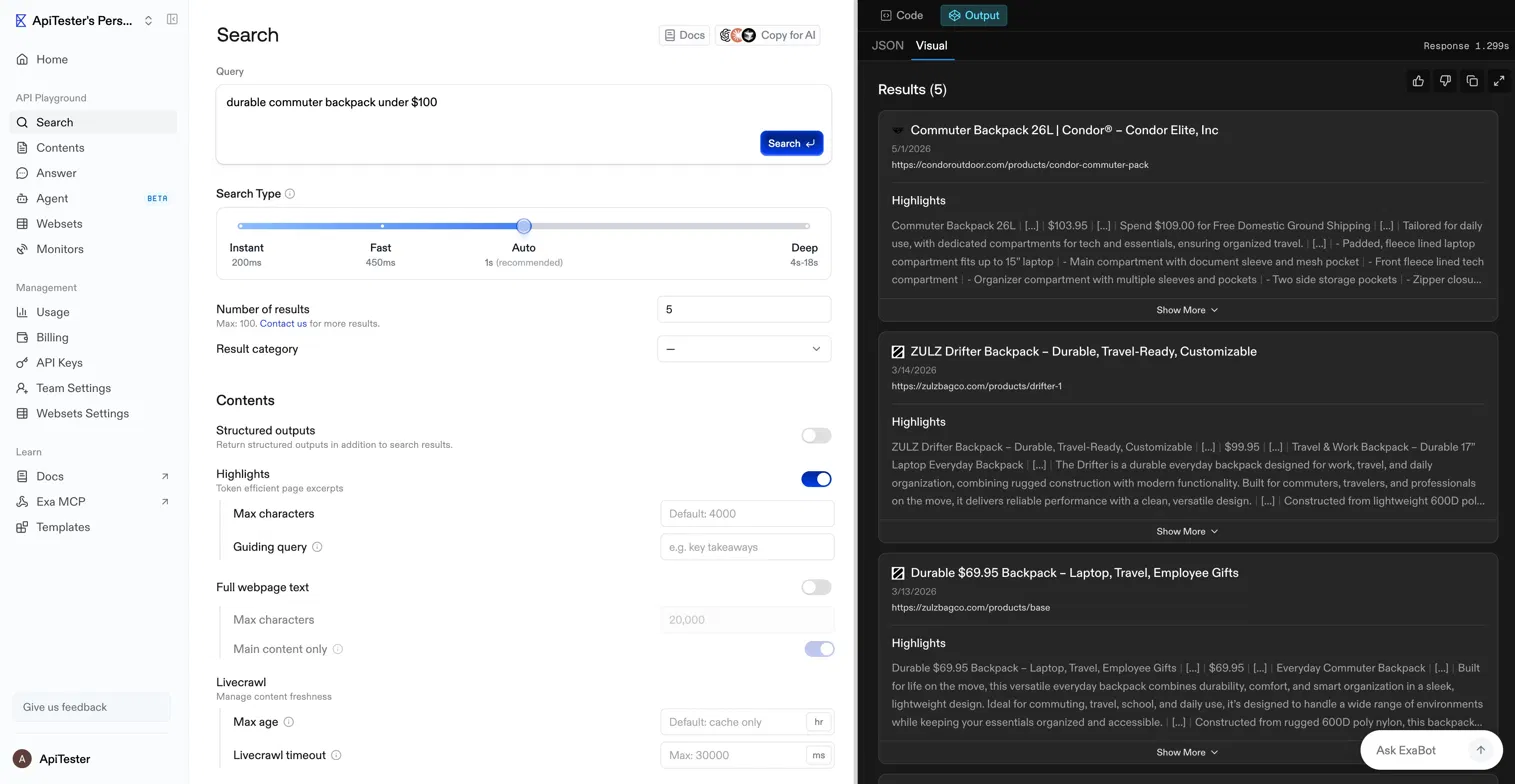
The first one I tested returned five results in 1.3 seconds — okay, that's fast! But the "data" was raw text blobs pulled from web pages. Prices were buried somewhere in a wall of HTML content. No brand field. No retailer field. No buy link. If I wanted to build a shopping agent on top of this, I'd have had to write a whole extraction layer just to figure out how much the backpack costs. That's a lot of engineering for something that should be table stakes.
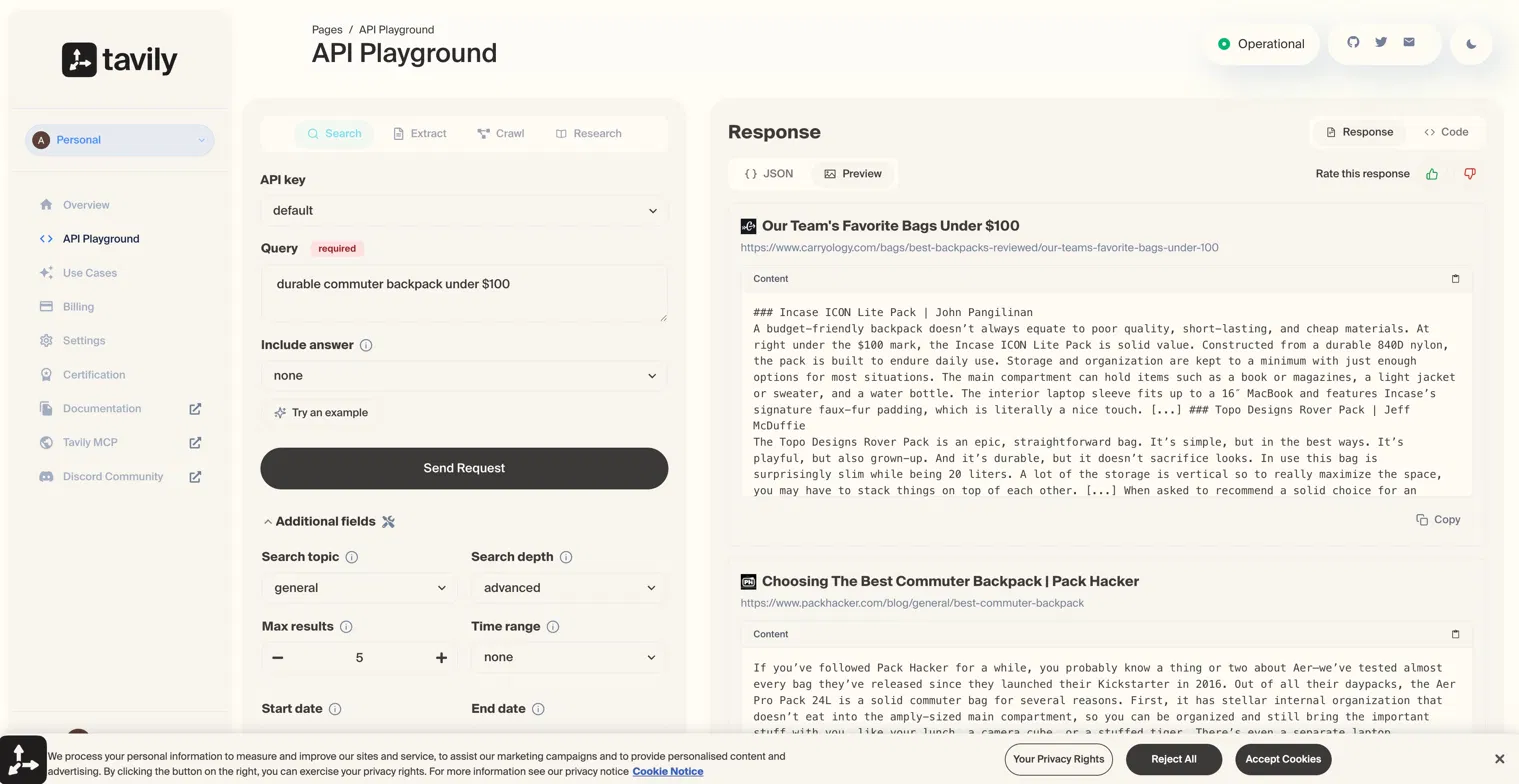
The second one I tried was even more disheartening. Five results in 3.2 seconds — and every single one was a blog article. "Our Team's Favorite Bags Under $100" from Carryology. "The 10 Best Backpacks of 2026" from Outdoor Gear Lab. Zero actual products. Zero prices.
Verdict: Great for research agents, RAG pipelines, anything where web content is the point. Completely wrong tool for AI shopping.
Category 2: SERP scraping APIs
Okay, now we're getting somewhere. SERP scrapers pull from Google Shopping, and Google Shopping has actual products with actual prices. The one I tested hands-on was SerpApi (its Google Shopping engine). My test returned 40 results in seven seconds — real backpacks with structured titles, prices, source sites, ratings, and thumbnail images.
Then I read the JSON more carefully. The response was enormous and full of opaque token strings that I had no idea what to do with. And the more I poked at it, the more limitations stacked up:
- No image search — you can only query by text. If a user uploads a photo and says "find something like this," you're out of luck.
- No structured filters — there's no way to constrain results by brand, category, gender, or specific website. You get whatever Google Shopping decides to surface.
- No deduplication — the same backpack from Bass Pro and Cabela's shows up as two separate results. Your agent has to figure that out.
- No built-in monetization — commission tracking is entirely on you to set up separately.
- Coverage gaps — limited to Google Shopping's index, so smaller DTC brands that aren't well-indexed there just don't appear.
- Price — SerpApi's Developer plan is $75/month for 5,000 searches, which adds up fast.
Channel3 vs. SerpApi, Oxylabs, and Rainforest API
SerpApi wasn't the only scraper on my list, so I also read through the docs and pricing for the other two names that kept coming up. Same story, different wrapper:
- Channel3 vs. SerpApi — SerpApi scrapes Google Shopping result pages; Channel3 returns deduplicated products with brand, price, retailer, and commission as first-class fields. Pricing: SerpApi starts at $75/month for 5,000 searches (250/month free); Channel3 is $7 per 1,000 queries after 1,000 free. Verdict: SerpApi for SEO and price monitoring, Channel3 for shopping agents. Full breakdown.
- Channel3 vs. Oxylabs — Oxylabs' Web Scraper API is general-purpose scraping infrastructure: you point it at Google Shopping or a retailer page and get back parsed HTML, then normalize the fields yourself. Pricing starts at $49/month, billed per successful result (about $1 per 1,000 Google results on the entry plan). Verdict: a strong tool if you want to build and maintain your own product pipeline; Channel3 if you'd rather not.
- Channel3 vs. Rainforest API — Rainforest API is Amazon-only: product pages, reviews, prices, and Buy Box data by ASIN, with search across Amazon marketplaces. Pricing starts at $83/month for 10,000 credits (billed annually). Verdict: the best option if your agent only recommends Amazon listings; Channel3 if it needs Nike, Nordstrom, Best Buy, and 25,000+ other brands and retailers alongside them, with commission built in.
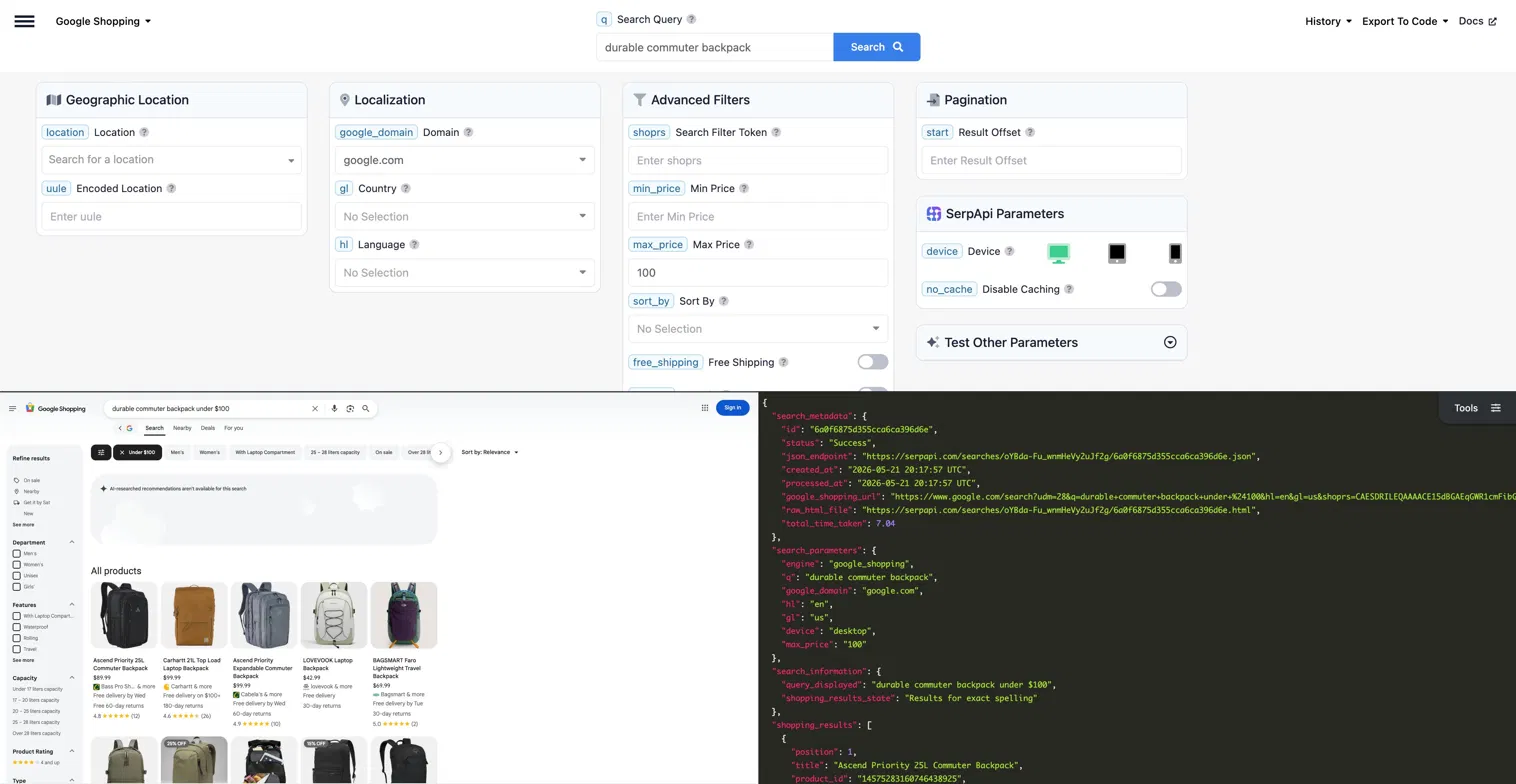
Verdict: SerpApi, Oxylabs, and Rainforest API are solid for price monitoring and competitive intelligence. Not quite right for building a full AI shopping agent — too much cleanup, limited coverage (one search engine or one marketplace), no built-in monetization.
Category 3: Shopify Catalog
I was genuinely impressed at first. Shopify's Catalog API lets you search across every eligible Shopify merchant, and the Dev Dashboard has a playground where you can test queries right in the browser. I ran my backpack query, set max price to $100, and got results in about a second.
The JSON is detailed — each product includes a title, description, AI-generated selling points, tech specs, variant-level pricing, images, color/size options, ratings, and direct checkout URLs. The deduplication works too — the Banjo Brothers backpack grouped variants from banjobrothers.com and velomine.com under one Universal Product.
But then I looked at what came back:
- Shopify merchants only — every result was from a smaller DTC shop: Ridge, Elea's Attire, Luxicro, Banjo Brothers, Ybackpacks.com. No Nike. No North Face. No Herschel. No major retailer.
- No brand field — there's no structured
brandin the response. You'd have to infer it from the shop name or parse the title. - Inconsistent result quality — one result was from a "Recomaze Demo Store" on a myshopify.com subdomain. Another was priced in Nigerian Naira despite my USD filter. A store literally called "PRODUCTS" at p-roducts.com showed up.
- No built-in monetization — no commission anywhere in the response.
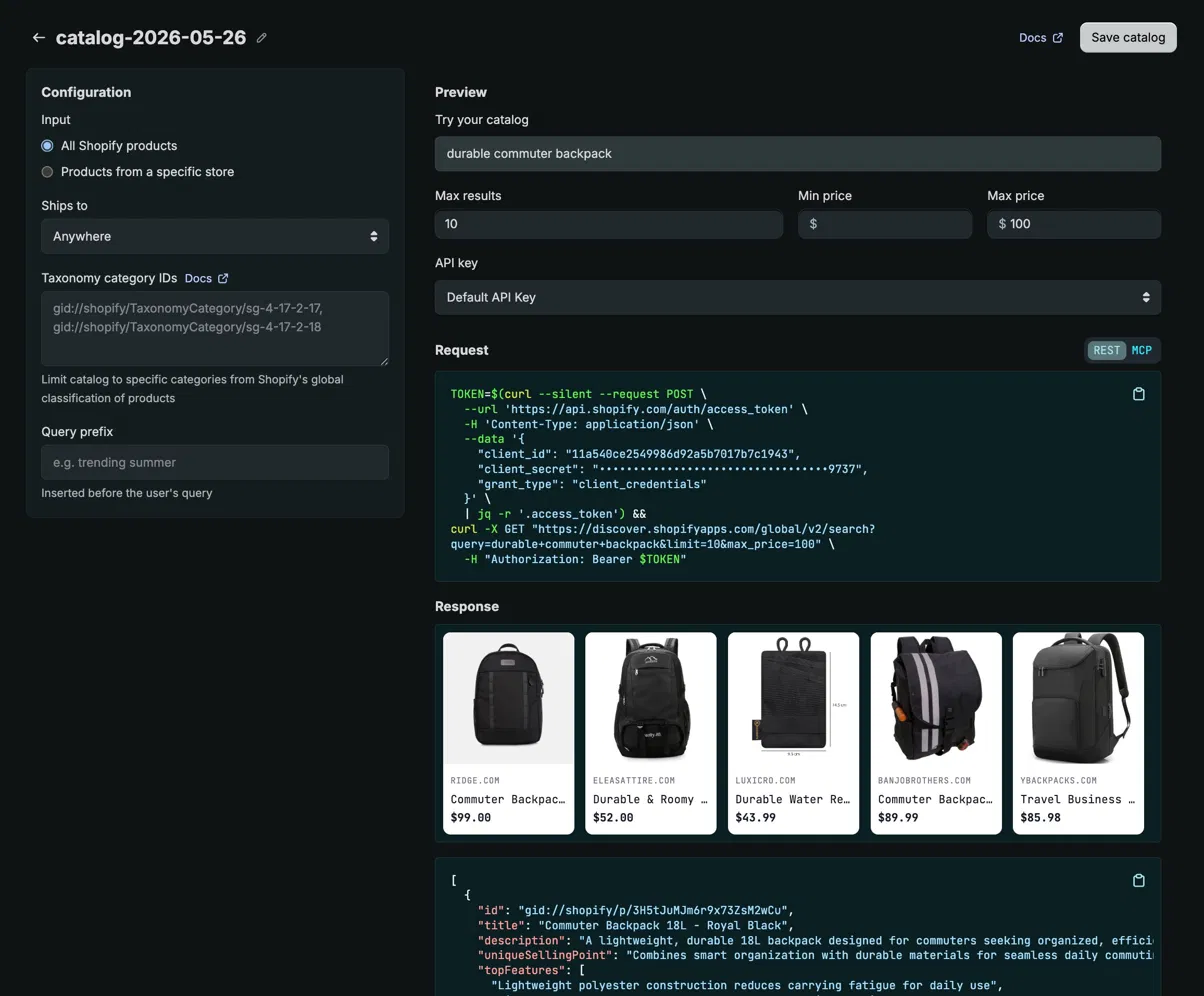
Verdict: The data structure is the richest of anything I tested, but Shopify-only coverage means no major brands, and the result quality was inconsistent. Great for the Shopify ecosystem; limiting if your agent needs to search the whole market.
Category 4: Channel3 (yes, my employer — but hear me out)
I want to be upfront: I obviously have some bias here, being a Channel3 intern and all. But I genuinely didn't understand how different this was until I ran the same query and looked at the output side by side.
Same query: "durable commuter backpack" with a $0–$100 filter. Results in under a second. And instead of text blobs or opaque tokens, here's what came back:
- Product name — Nike NSW Commute Backpack, Puma Contender Backpack, HP Commuter Laptop Backpack, The North Face Jester Backpack, and more — as a clean string field
- Brand — Nike, Puma, HP, The North Face — structured, not buried in a description
- Price — $24.69, $30.19, $79.00, $90.00, $95.00 — actual numbers, not "approximately ninety dollars" somewhere in paragraph four
- Retailer — nike.com, footlocker.com, nordstrom.com, staples.com — multiple retailers per product
- Images — ready to display, no extra fetching required
- Commission rate — up to 3–8.4% depending on the retailer, built right in
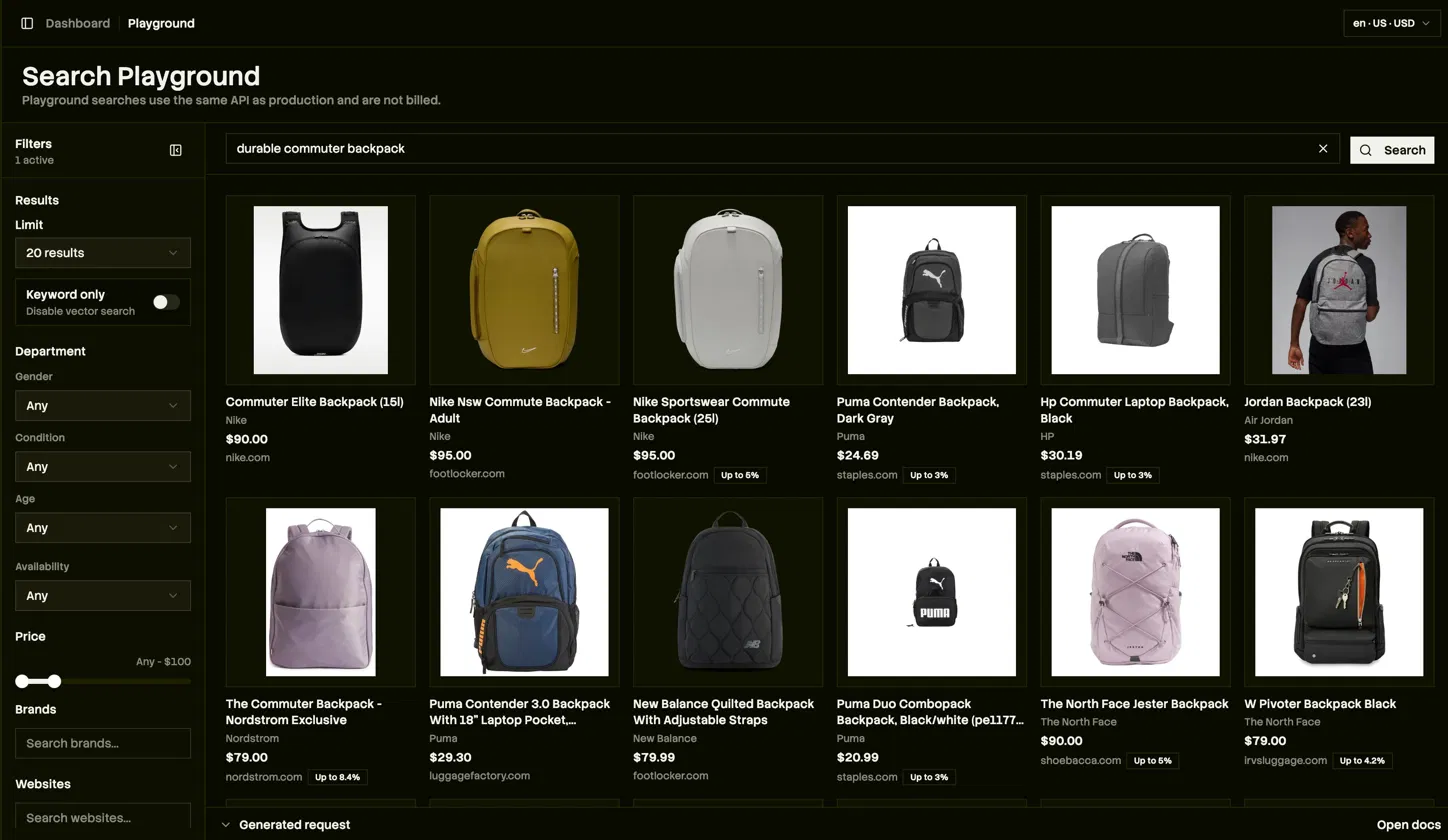
The Nike NSW Commute Backpack shows up once, with multiple retailer options attached — not as five separate listings from five different stores. An agent can say: "Here's that Nike backpack for $90 at nike.com, or $95 at Foot Locker." Clean, useful, ready to present.
There's no extraction pipeline to write. No normalization layer. No commission program to sign up for separately. You query the API, you get back products, you show them to the user, you earn commission when they buy. I set up a working demo in an afternoon, which would have taken me days with any of the other approaches.
The catalog spans more than 100 million products across tens of thousands of brands. The team uses multimodal AI to read product pages, match duplicates across merchants, link variants like color and size, and extract rich attributes — so agents can reason about products the way a person would. After testing everything else, I finally understood why Alex and George decided this problem needed its own company.
Pricing: 1,000 free searches to start (I burned through mine fast), then $7 per 1,000 queries.
My comparison table
Here's how everything stacked up across the dimensions I cared about most for an AI shopping agent:
| Channel3 | Web search API | Web search API #2 | SerpApi (SERP scraper) | Shopify Catalog | |
|---|---|---|---|---|---|
| Returns actual products | Yes | Sometimes (unstructured) | No — just articles | Yes | Yes |
| Structured price field | Yes | No (buried in text) | No | Yes | Yes (price range) |
| Brand + retailer as fields | Both | No | No | Source only | Shop name only |
| Cross-retailer coverage | 25,000+ brands | Random | N/A | Google Shopping only (Oxylabs: per-site; Rainforest: Amazon only) | Shopify merchants only |
| Product deduplication | Yes | No | N/A | No | Yes (Universal Products) |
| Image search | Yes | No | No | No | No |
| Filter by brand / category / gender / site | Yes | No | No | No | Partial (price, shop, country) |
| Built-in monetization | Yes (3–8.4%) | No | No | No | No |
| Entry pricing | 1,000 free, then $7 / 1,000 queries | Varies | Varies | $75/mo for 5,000 (Oxylabs from $49/mo; Rainforest from $83/mo) | Free |
| Response time | < 1s | 1.3s | 3.2s | 7.0s | ~1–2s |
| Time to working demo | One afternoon | Days (needs parsing layer) | N/A | Days (needs cleanup) | Hours (Shopify-only scope) |
Try it yourself
If you're building an AI shopping agent, start with Channel3. 1,000 free searches, no credit card required. Excited to see what you build!
— Shrivi, Intern @ Channel3
Newsletter
Get new posts in your inbox
Field notes from the rapidly changing world of AI commerce